Templates & the IM model
Templates are how Kybera Impact makes every new workspace look and behave the way your organization intends — consistently, automatically, every time. The IM model is the broader layer they're built on: enterprise content types, site columns, taxonomy, and Business Authority that every workspace inherits the moment it exists.
What your IM model includes
- Enterprise site columns. Reusable columns that mean the same thing across your tenant — so a Document Status column on a project workspace and on a department workspace carry the same meaning, the same values, the same defaults.
- Enterprise content types. Meaningful groupings of columns (a Contract, a Meeting Minute, a Project Charter) that your business lines apply through the catalogue rather than recreating from scratch.
- Bilingual taxonomy. Term sets in the Microsoft 365 term store with English and French default labels and synonyms — the controlled vocabulary your business runs on.
- Business Authority. A two-level, bilingual business hierarchy that classifies every workspace by who owns its content. Travels with the workspace into compliance, audit, records, and reporting.
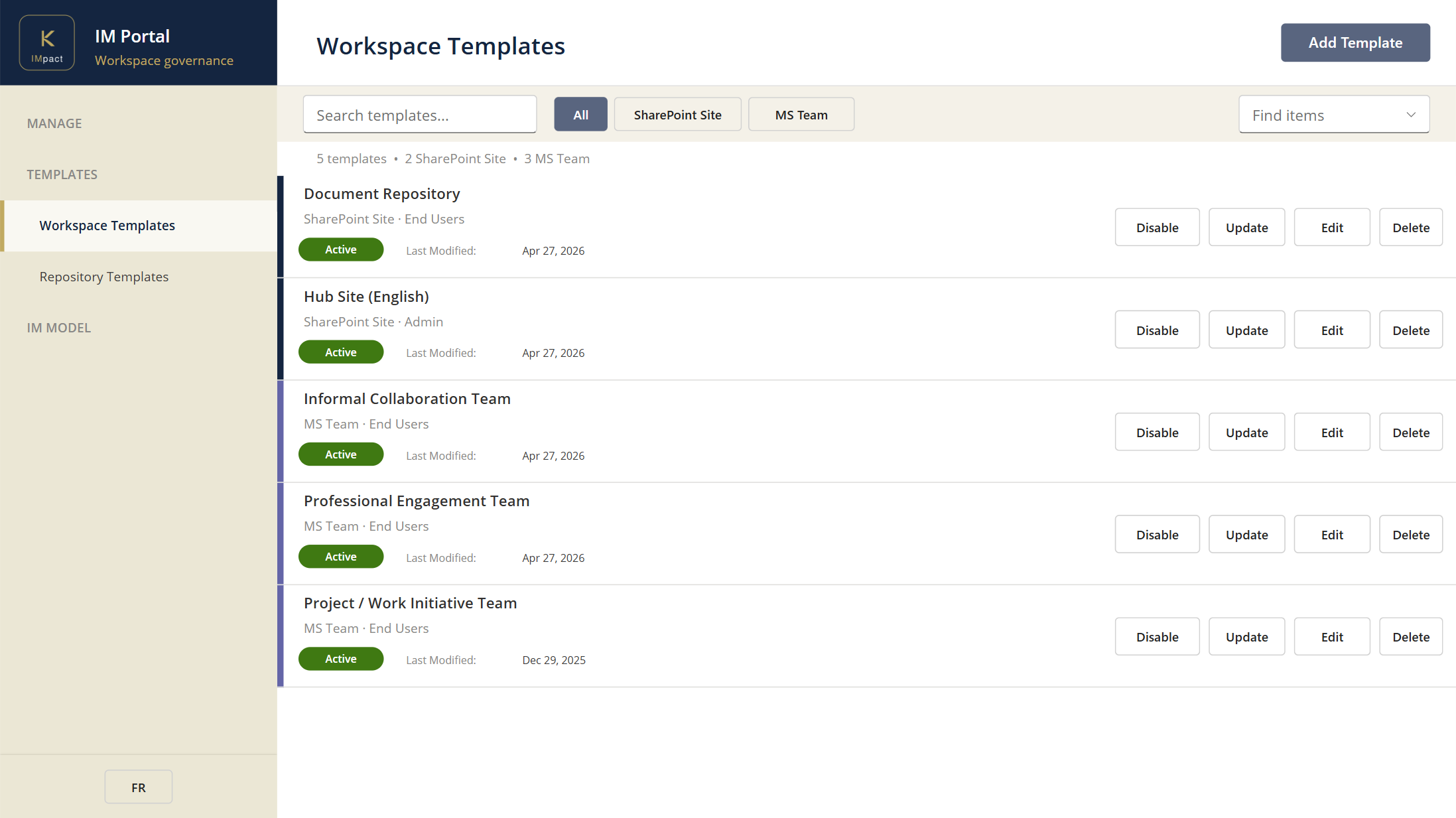
- Workspace and library templates. Configured visually in SharePoint by your IM team — then exported through the IM Portal and published as the new standard.
Why your organization benefits
- The IM model is deployed first, not retrofitted. Most Microsoft 365 deployments try to roll out enterprise information architecture after sites already exist — and rarely finish the retrofit. Kybera Impact inverts the order: your IM model is in place from day one, and every new workspace inherits it automatically.
- Templates designed by your IM team, in SharePoint. Your IM team builds templates the same way they build any other SharePoint site — visually, with the SharePoint experience they already know. The IM Portal handles the export, versioning, and publication.
- Compliance keeps the model real. Drift in templates, columns, or content types gets corrected automatically. The IM model your organization invested in stays applied on every workspace, not just on the unused ones.
- One model, two languages. Bilingual is a first-class property of the IM model — not a phase-two project that never quite happens.
Where this fits
The IM model is maintained through the IM Portal. Templates drive Provisioning. The audit's Schema Integrity KPI measures whether the model is staying intact in real use; Compliance puts it back when it drifts.